
Lariat Necklaces Are Having a Moment! Here’s How to Wear One
A lariat necklace is the one piece in your jewelry box that refuses to lie flat or sit still — no clasp, no fixed length, just one long strand you loop, knot, or drape until it does exactly what you want. That's the whole appeal of a lariat: the same design reads quiet and polished with a turtleneck, or full sultry-siren with a plunging neckline, depending entirely on how you tie it. Below is a complete guide to lariat necklaces — what they are, how long to buy, how to tie one in under a minute, and five ways to wear one that hold up well outside a lookbook, too.
What Is a Lariat Necklace?
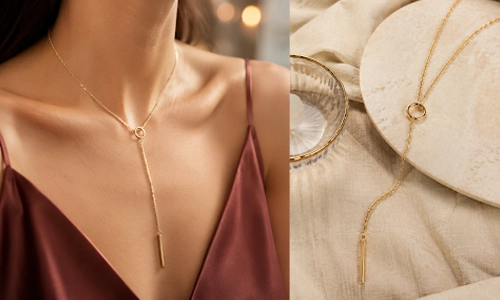

A lariat necklace is a necklace with no clasp: a single continuous strand or chain that wraps, loops, or threads through itself — often through a small ring or fixture near the top — rather than closing with a hook. That sliding, adjustable construction is exactly where the name comes from. "Lariat" is the English form of the Spanish la reata, "the rope," the same word used for a cowboy's lasso. The Oxford English Dictionary traces "lariat necklace" as a jewelry term back to 1916, when Art Deco jewelers began reworking the shape in platinum, diamonds, and pearls.
Structurally, a true lariat is different from a Y-necklace, even though the two names get used interchangeably online. A Y-necklace has a fixed clasp and a fixed-length drop; a lariat has neither. That's not a technicality — it's the entire reason a lariat is more versatile than almost anything else in your jewelry box. The same necklace can sit as one long drop today and a wrapped choker tomorrow, because nothing about it is locked in place.
Lariat Necklace Structure: How It's Built
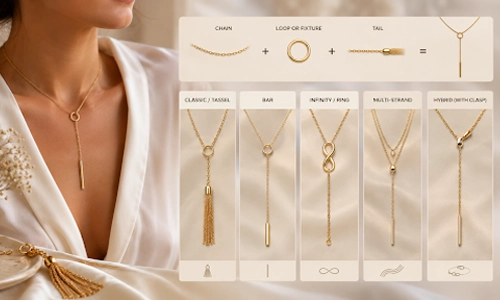
Every lariat shares the same basic anatomy: a long chain or strand, a small loop, ring, or decorative fixture built into the chain, and a "tail" — a tassel, bar, gemstone, or charm — finishing one or both ends. You thread or wrap the strand through that fixture to hold your shape, which is what lets you change the drop length and silhouette just by adjusting where you pull it through.
From there, lariats branch into a few builds worth knowing when you're shopping:
- Classic or tassel lariat — an open-ended chain finished with a tassel, bead, or fringe drop. The most traditional build, and the most adjustable.
- Bar lariat — a slim, horizontal bar sits at the base of the drop for a cleaner, more minimal line. Reads more office than boho.
- Infinity or ring lariat — the sliding fixture itself is a decorative loop or figure-eight shape rather than a plain jump ring, so it doubles as a design detail instead of hiding at the nape.
- Multi-strand lariat — several chains of varying lengths drape together for a fuller, already-layered look without stacking multiple separate necklaces.
One note on hybrids: some newer designs add a small clasp for security while keeping the lariat's signature drop. That's genuinely useful if you find true lariats fussy to adjust — though technically, once the clasp goes in, you're closer to wearing a Y-necklace than a lariat.
Lariat Necklace Length: Finding the Right Fit
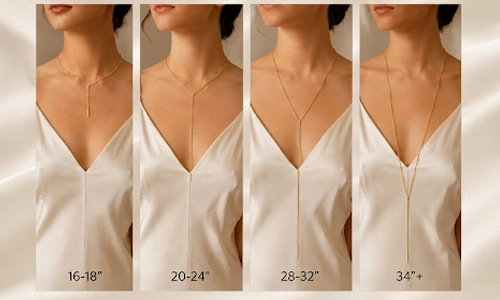
Because a lariat's drop is vertical rather than circular, length matters more here than with almost any other necklace style. As a starting point:
- 16–18 inches — sits at or just below the collarbone with only a few inches of drop. Good for layering under a shorter choker or filling in a crewneck.
- 20–24 inches — the most versatile lariat length, landing around the center of the chest. This is the size to buy first if you're only buying one.
- 28–32 inches — long enough to wrap once around the neck with drop left over, or to sit low against a deep V-neck or wrap dress.
- 34 inches and up — built for wrapping. Double it for a choker effect, knot it, or cross the ends; a lariat this long functions as a styling tool as much as a necklace.
If you're torn between two lengths, size up. A lariat that runs slightly long can always be shortened by wrapping or knotting it; one that's too short can't be stretched.
How to Tie a Lariat Necklace
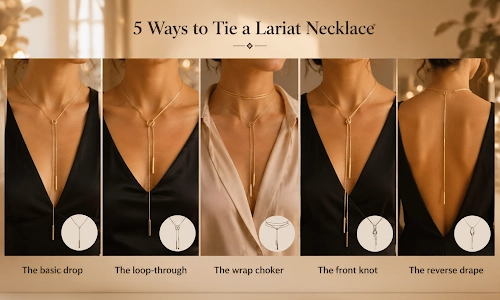
Most lariats are tied one of a few ways. Here are the five worth learning:
- The basic drop — Drape the lariat around your neck with the fixture centered at your throat and let both ends fall straight down the front. The no-styling-required option, and the most flattering with deep necklines.
- The loop-through — Cross both ends in front of your chest, thread one end through the loop you've just created (the same motion as starting a shoelace knot), then let the ends hang at uneven lengths. This is the classic lariat knot, and it tightens slightly on its own as you move.
- The wrap choker — Fold the chain in half, wrap it around your neck once or twice so the fold sits at the nape, then thread the two loose ends through the loop at the front and let them drop. Best for longer lariats (28 inches or more) and higher necklines.
- The front knot — Bring both ends together at the center of your chest and tie one loose overhand knot, letting the tails hang uneven below it. It should look more found-object than fussed-over — that's the point.
- The reverse drape — Turn the lariat around so the tail hangs down your back instead of your front. Built for backless dresses and open-back tops, where the chain becomes the detail instead of the neckline.
None of these require jewelry-making skills, just patience the first time.
A quick note from experience: The wrap choker is the one people get wrong first, usually by tightening before adjusting the loop, which leaves the knot sitting off to one side at the back of your neck instead of centered at the nape. Loop first, adjust the drape, then tighten last. Do it in front of a mirror twice and your hands stop needing the mirror.
How to Wear a Lariat Necklace: 5 Pairings to Try
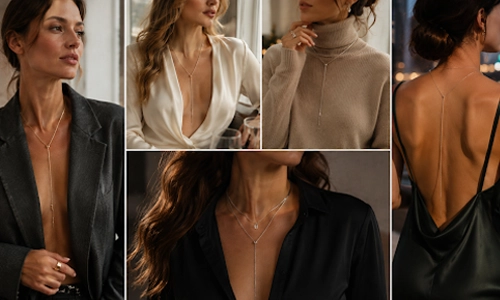
Once you know how to tie one, the real question is what to wear it with. Five pairings that hold up outside a shoot:
- A tailored wool blazer, worn open — Let a mid-length lariat fall down the center of your chest as the one piece of jewelry doing all the work. Skip earrings if the drop has any real weight to it.
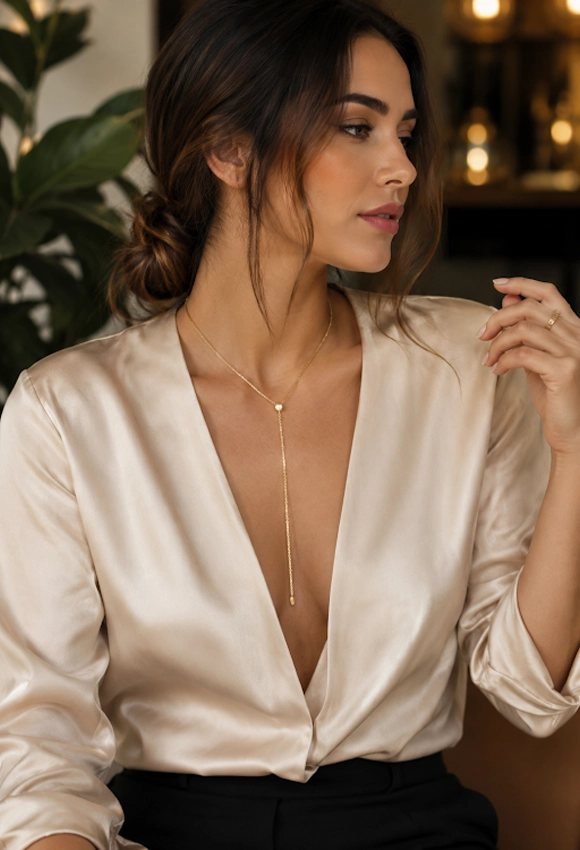
- A plunging or V-neck silk top — The lariat's drop follows the neckline instead of fighting it, which is why this is the pairing every lariat product photo reaches for first.
- A cashmere turtleneck or crewneck, wrapped — Double-wrap a longer lariat so it sits like a choker against a high neckline, breaking up what would otherwise be one flat block of color.
- A slip dress or backless silhouette, reversed — Turn the lariat around so it drapes down your spine instead of your chest. It's about as close as jewelry gets to being designed specifically for your back.
- A second, shorter necklace, layered — Keep the lariat as the longest piece and let a shorter pendant or chain sit above it. It's the same logic behind the Audry Rose diamond lock-and-lariat pairing Taylor Swift has reached for repeatedly since a November 2025 date night in New York, re-worn as recently as this past April — proof that "layer a lariat with something shorter" isn't just a stylist's rule, it's a genuinely repeatable one.
Pearl Lariat Necklaces: The Elevated Classic
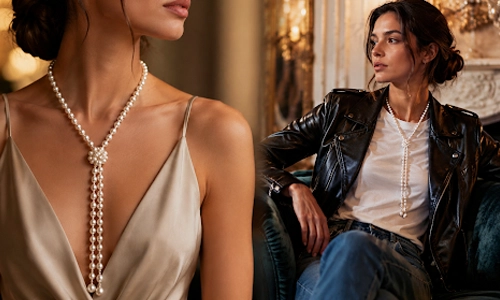
Swap a metal chain for a strand of pearls and you get a pearl lariat — historically one of the style's most iconic forms. Long ropes of pearls, worn wrapped or knotted low on the chest, were a signature of 1920s eveningwear, and the silhouette never really left; it just keeps getting restyled. Michelle Yeoh wore a pearl lariat necklace with dangling diamond earrings at the Visit Malaysia 2026 launch in Kuala Lumpur this past January, paired against a bright yellow Balenciaga gown — proof that the high-contrast combination of soft pearls against a bold, saturated color still reads as red-carpet-ready almost a century after the style first caught on.
Pearls are also where lariats are getting genuinely modern right now: rather than saving a pearl lariat for eveningwear only, try it against unexpected textures — a leather jacket, a plain white tee, raw denim. The tension between the pearl's softness and something harder-edged is what keeps the pairing from reading dated.
Lariat Necklace with Pendant: Adding a Personal Touch
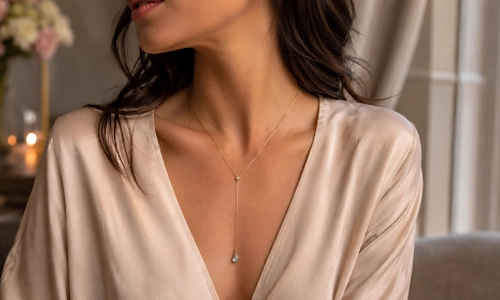
Not every lariat ends in a plain tassel or bar. Plenty are designed with a pendant at the drop — a single gemstone, a birthstone, an initial, or a small charm that gives the piece a more personal, less purely decorative feel. A lariat necklace with a pendant works especially well as a layering anchor, since the eye naturally travels down the chain to whatever sits at the bottom.
If you're choosing one, treat the pendant the way you'd treat a signature ring: pick something with actual meaning — a birthstone, an initial, a symbol tied to a specific person or moment — rather than a generic charm. The whole point of a lariat's long, uninterrupted drop is to give one small detail room to be noticed. It's a quieter way to wear something sentimental than a locket, and a more grown-up one than an engraved bar necklace.
FAQ
1. Are lariat necklaces still in style?
Yes. Fashion press from Vogue to WWD has continued covering lariats through 2025 and 2026, and the style remains a fixture on both red carpets and runways. Because the silhouette isn't tied to a single trend cycle — it's been revived every few decades since the 1920s — it tends to read as classic rather than dated.
2. Do lariat necklaces have a clasp?
Traditionally, no. A true lariat has no clasp and holds its shape by looping or threading through itself. Some modern designs add a small clasp for convenience, which technically makes them closer to a Y-necklace, though many brands still market them as lariats.
3. What's the difference between a lariat and a Y-necklace?
A Y-necklace has a fixed clasp and a fixed drop length. A lariat has neither — it's a single adjustable strand you tie or wrap yourself, which is why it can be styled more than one way.
4. Can you wear a lariat necklace every day?
Yes. A simple gold or silver lariat in the 20–24 inch range works with everyday necklines like crewnecks, button-downs, and T-shirts, and takes seconds to tie once you've done it a few times.
5. How long should a lariat necklace be?
It depends on how you want to wear it: 16–24 inches for a single drop that sits above or at the center of your chest, and 28 inches or longer if you want enough length to wrap or knot.
However you tie it, a lariat necklace earns its place by doing more with less: one strand, endless configurations, zero clasps to fight with. Start with a mid-length piece in a metal you already wear daily, learn the loop-through first, and build out from there.